
Essential Resources for Community Empowerment
Discover: How we manage our Water!
A Fully Autonomous Bio-Water System in D’Kar, Botswana
In a dry, rural part of Botswana, we’ve built something unusual: a completely self-sufficient water and wastewater system for a local educational center. No grid, no municipal water, no sewer, just nature, simple technology, and smart design.
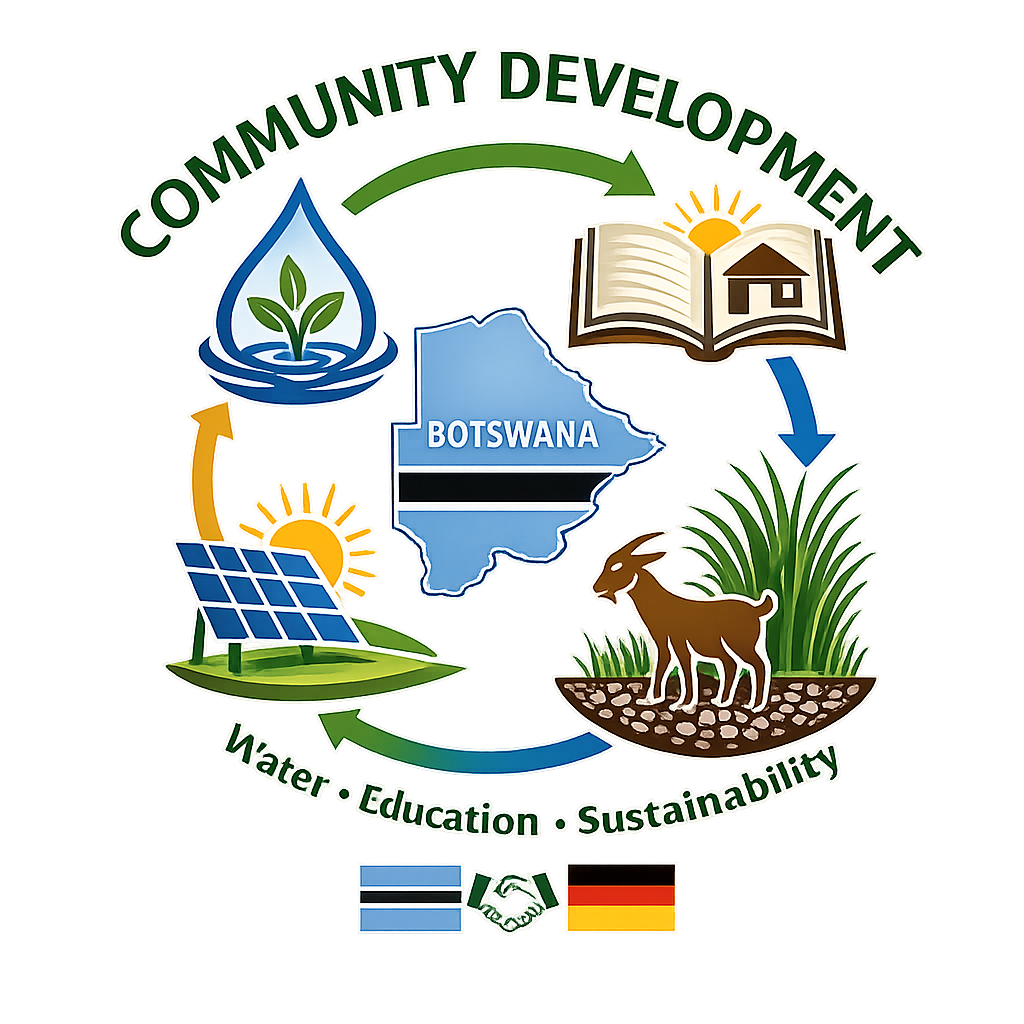
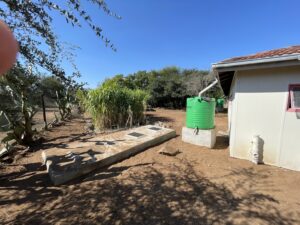
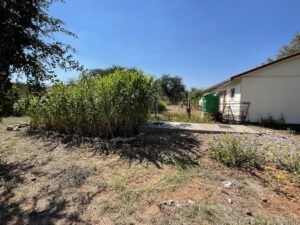

What we built (2025-2026):
Our project combines biological wastewater treatment with rainwater harvesting into our existing solar powered water system comprising of borehole, water tank and tower; to create a closed water cycle:
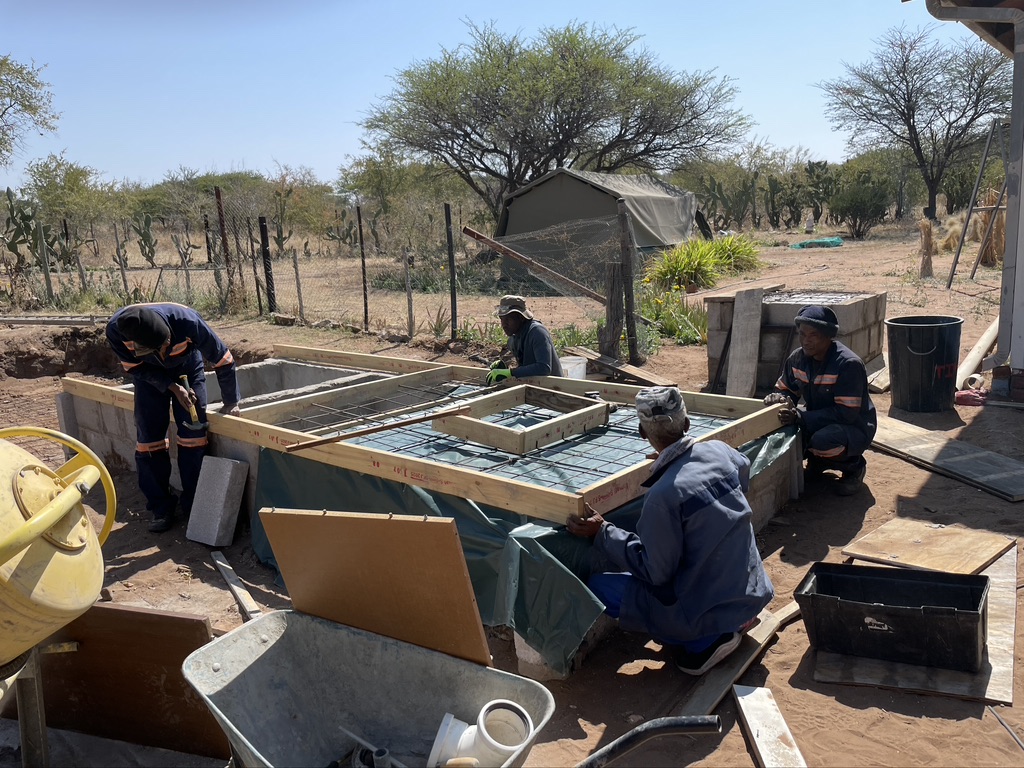
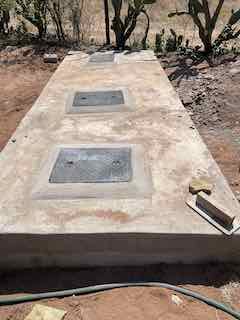
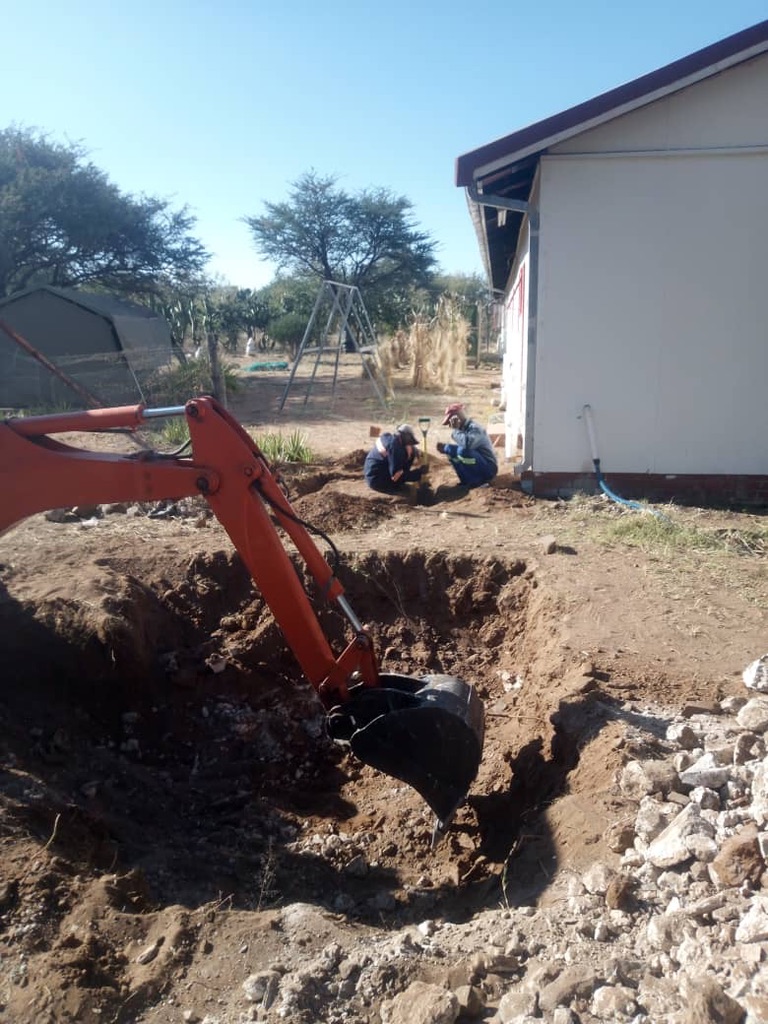
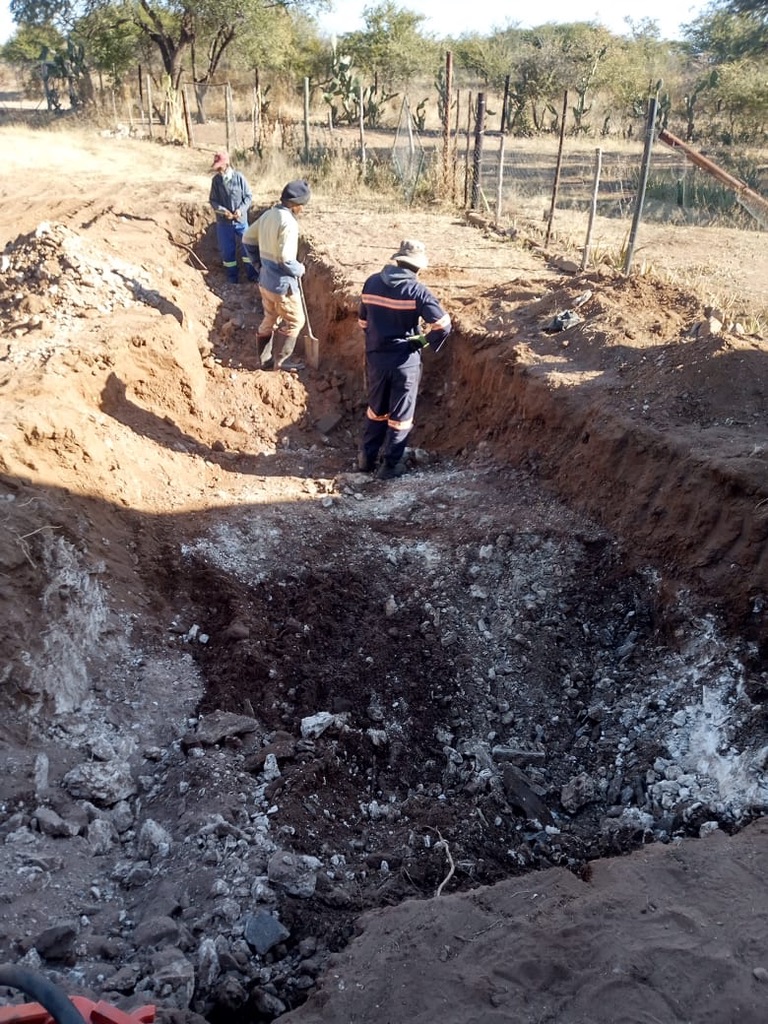
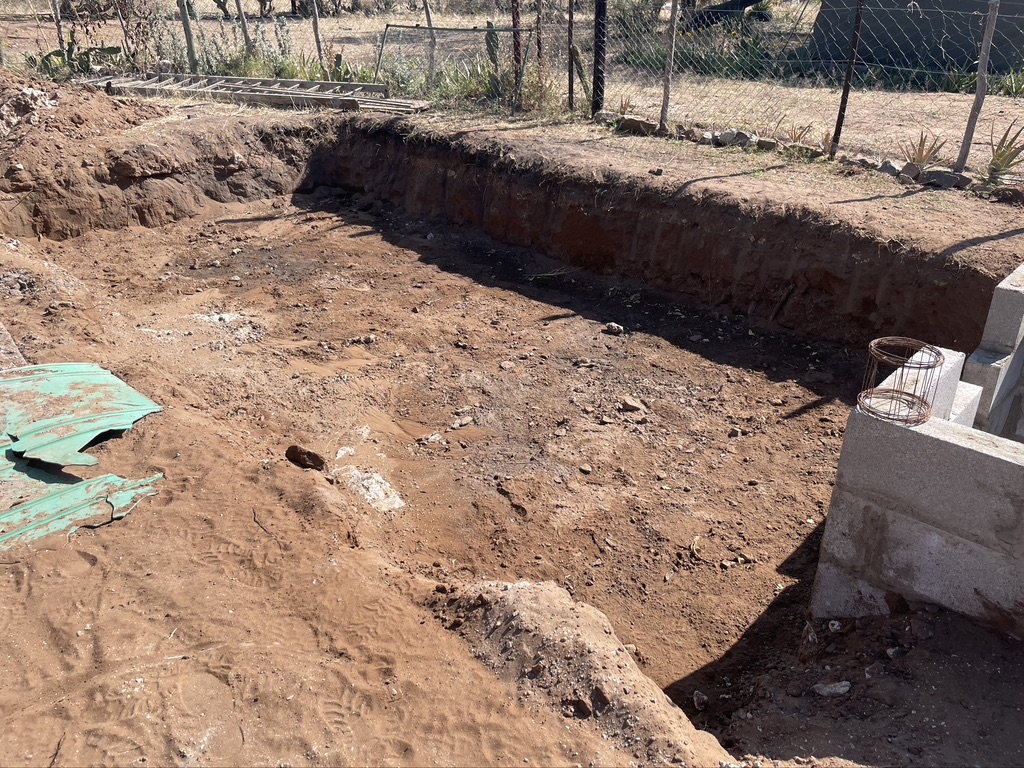
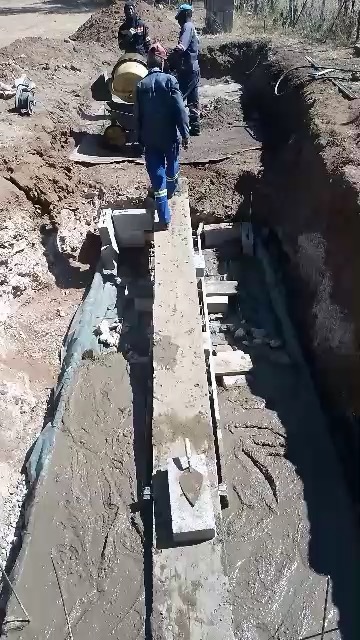
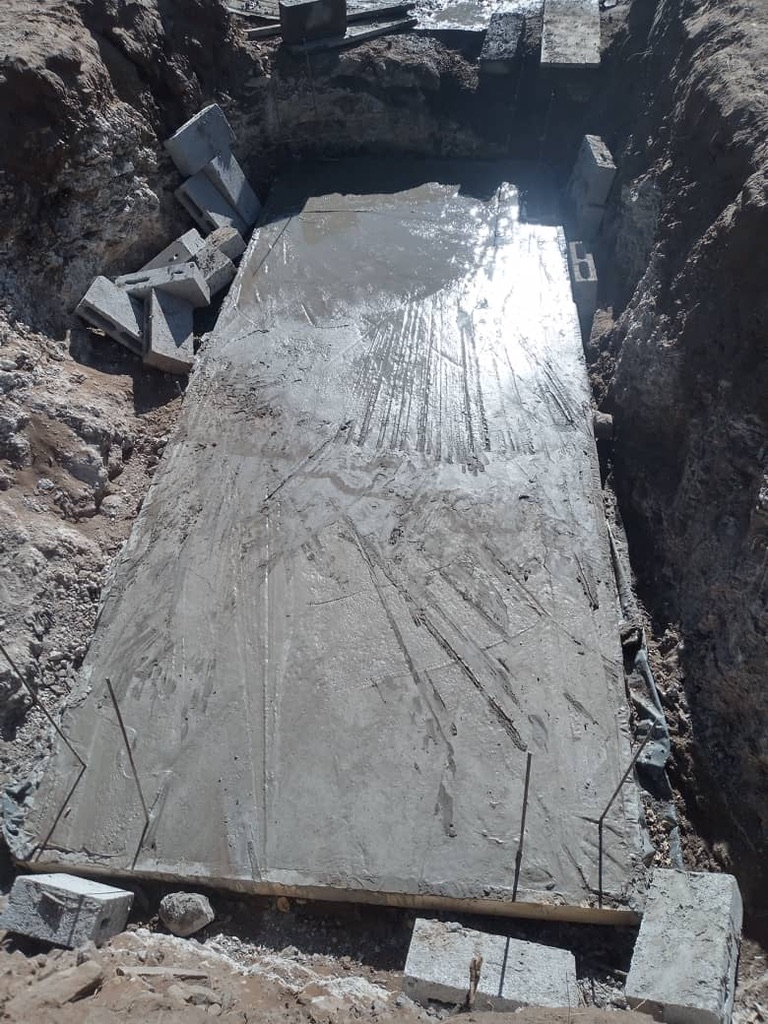
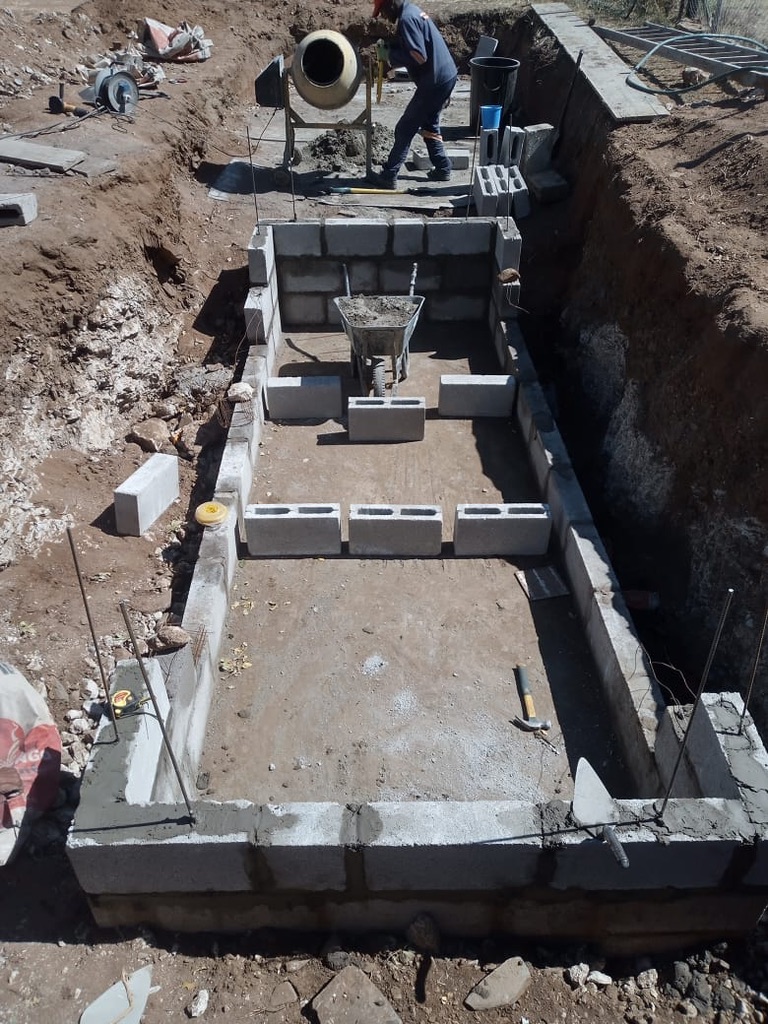
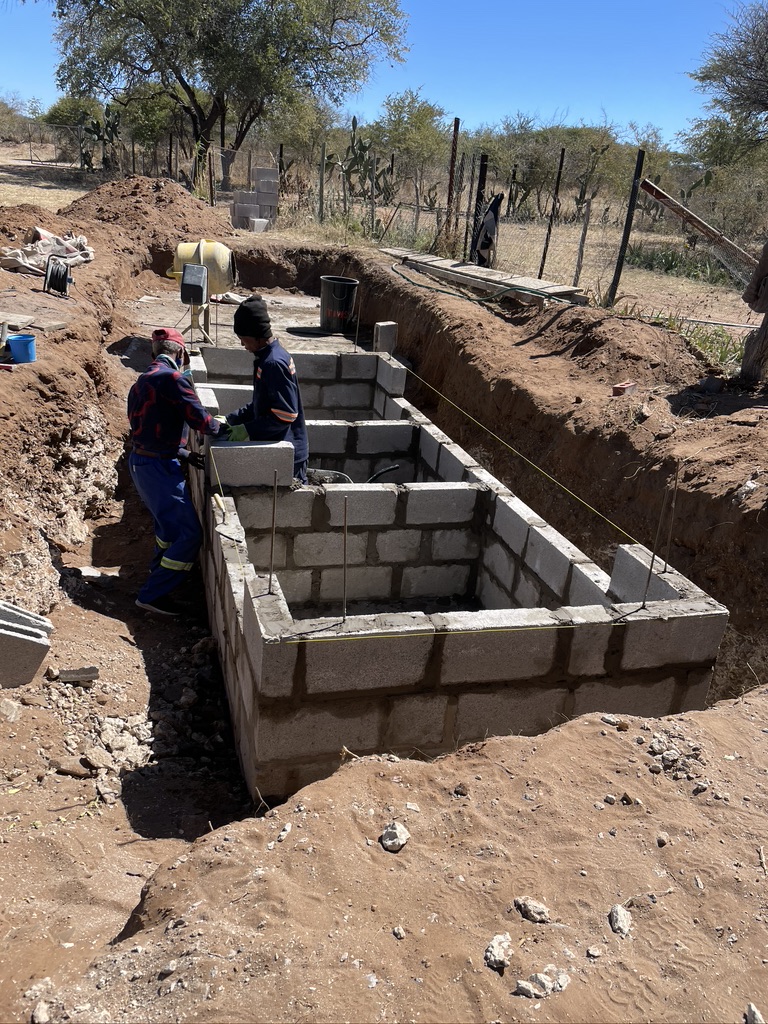
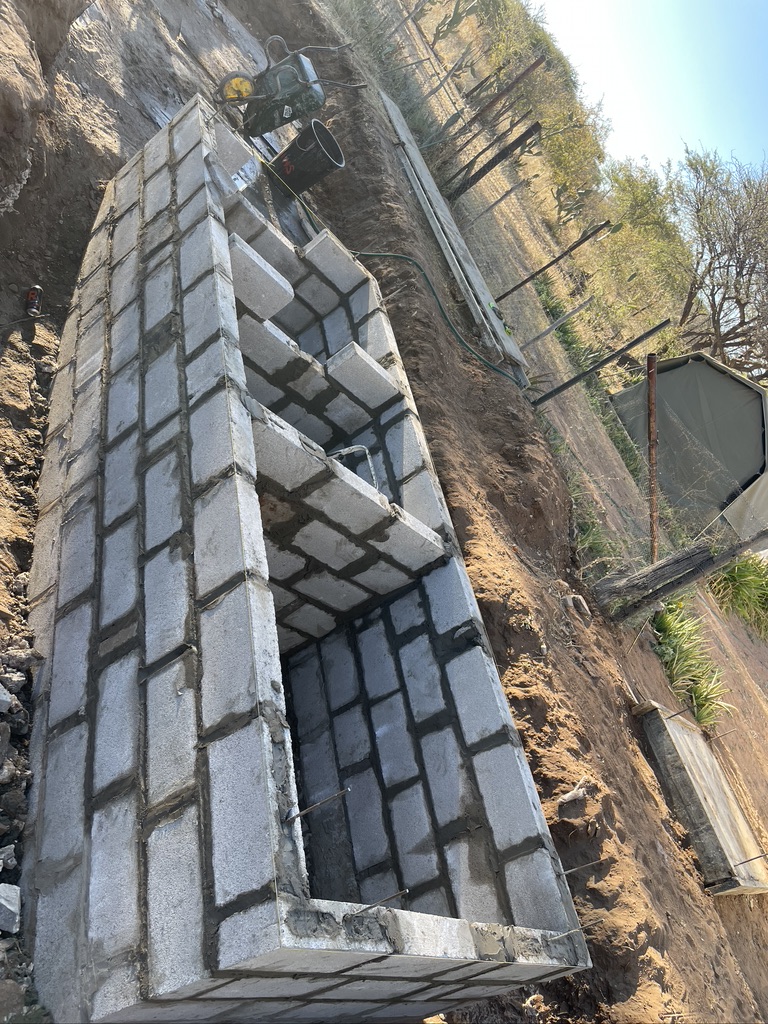
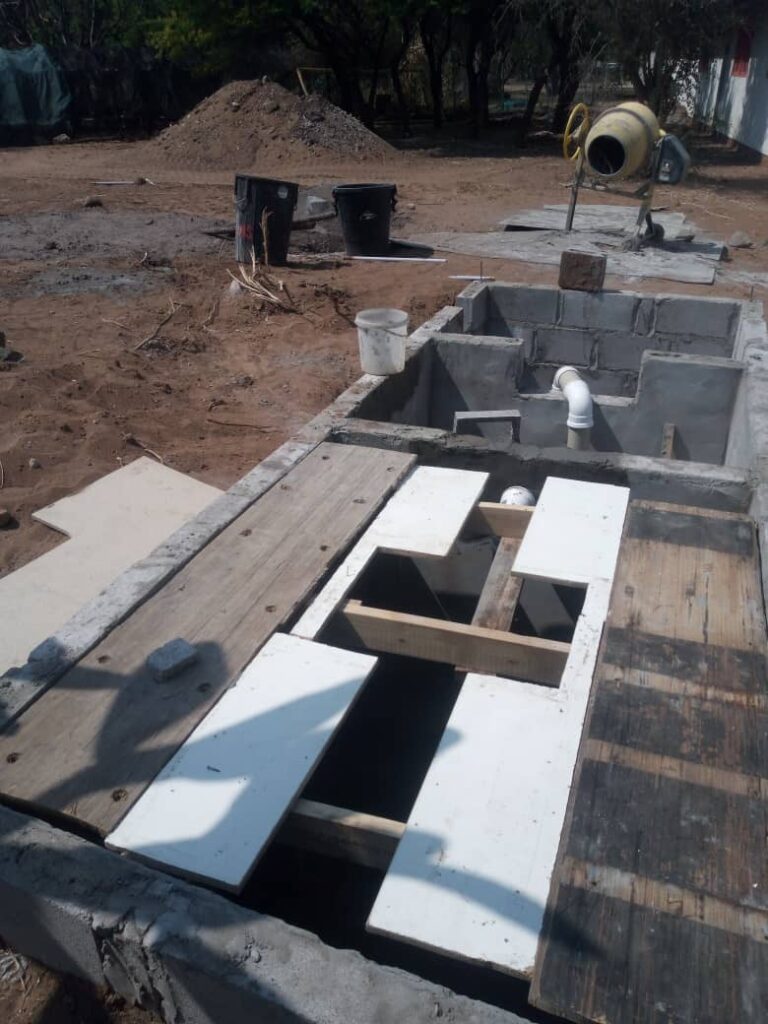
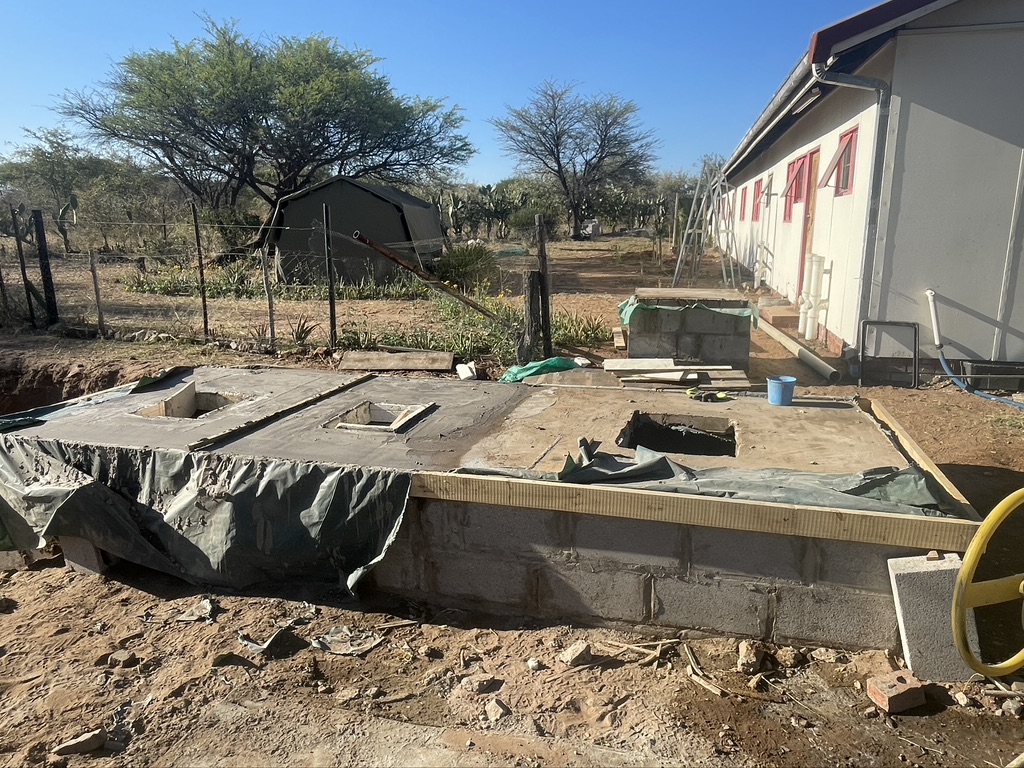
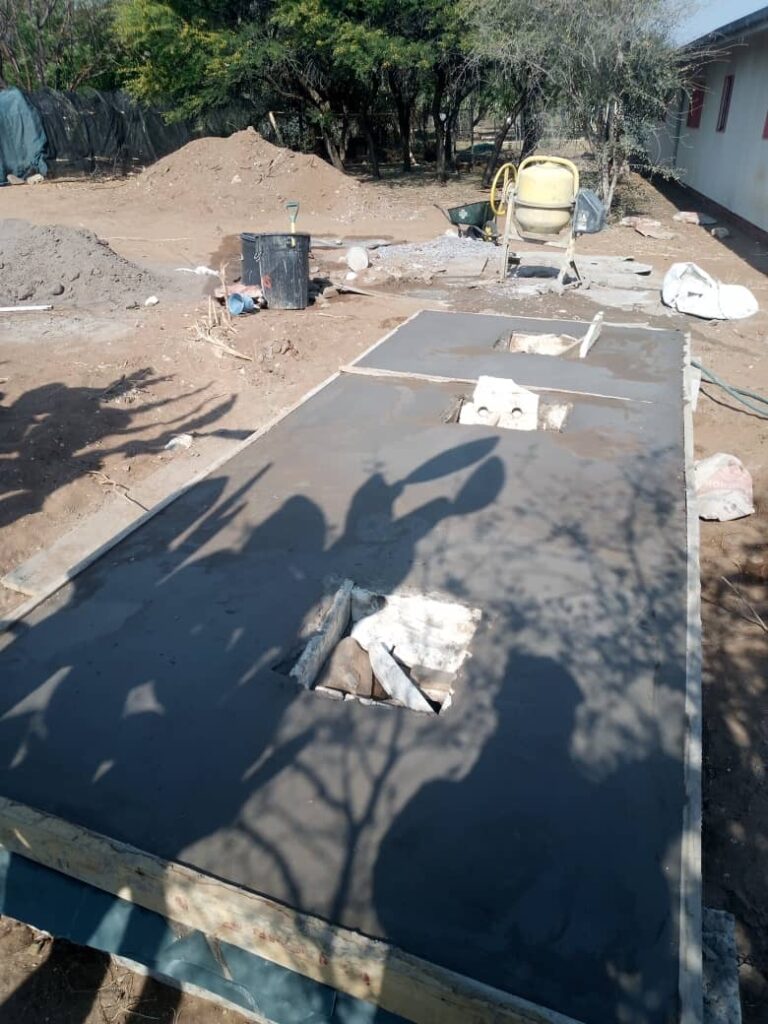
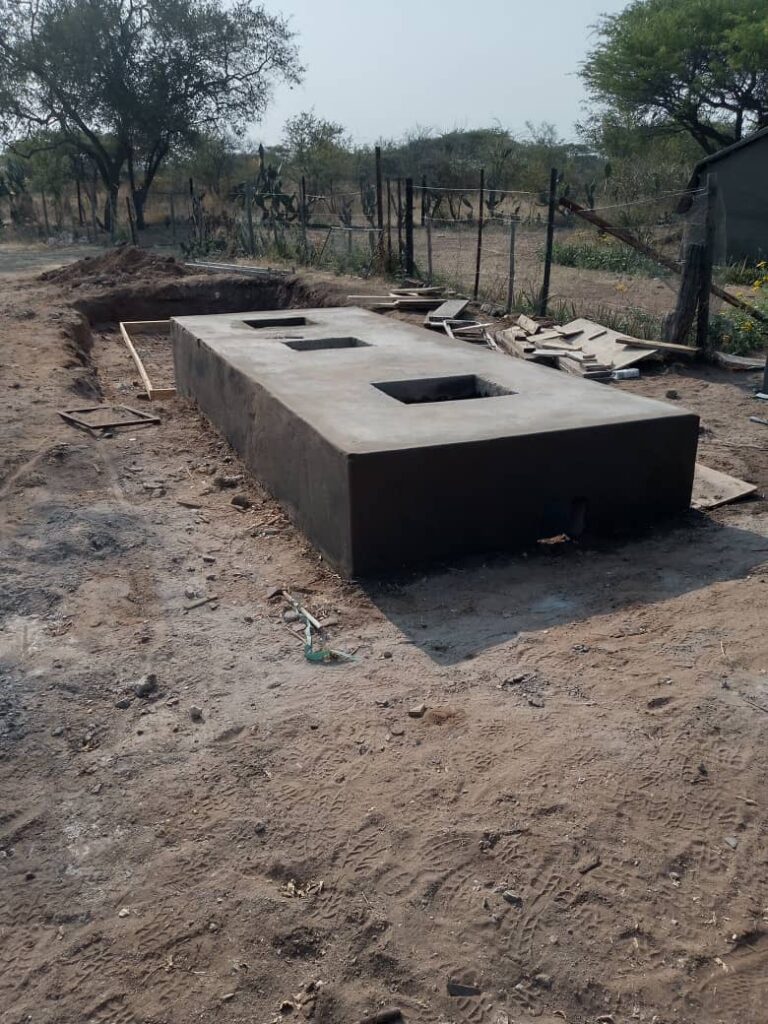
- 6 three-chamber septic tanks for five buildings (school, kitchen/dining, staff house, manager house, volunteer house)
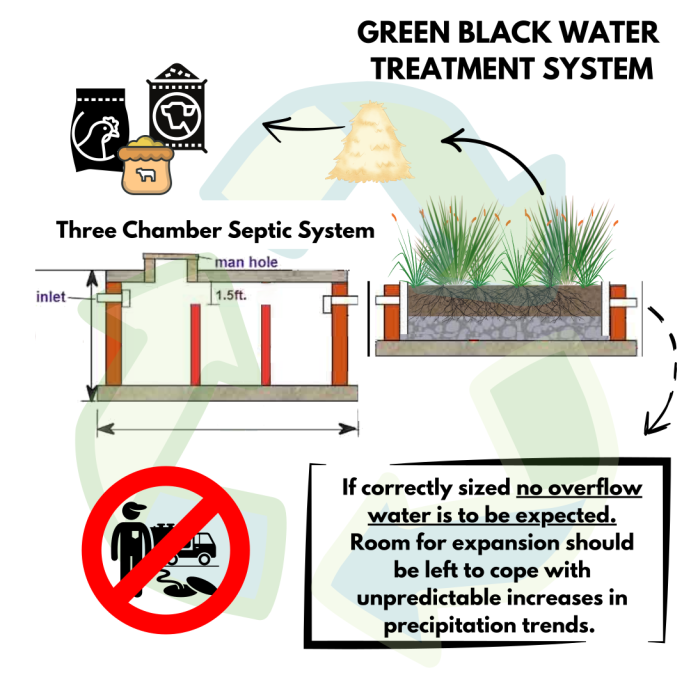
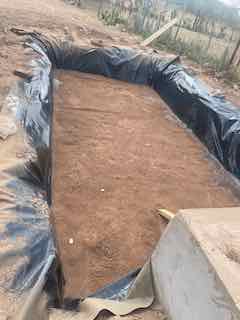
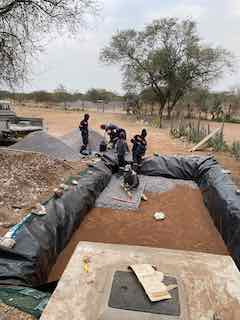
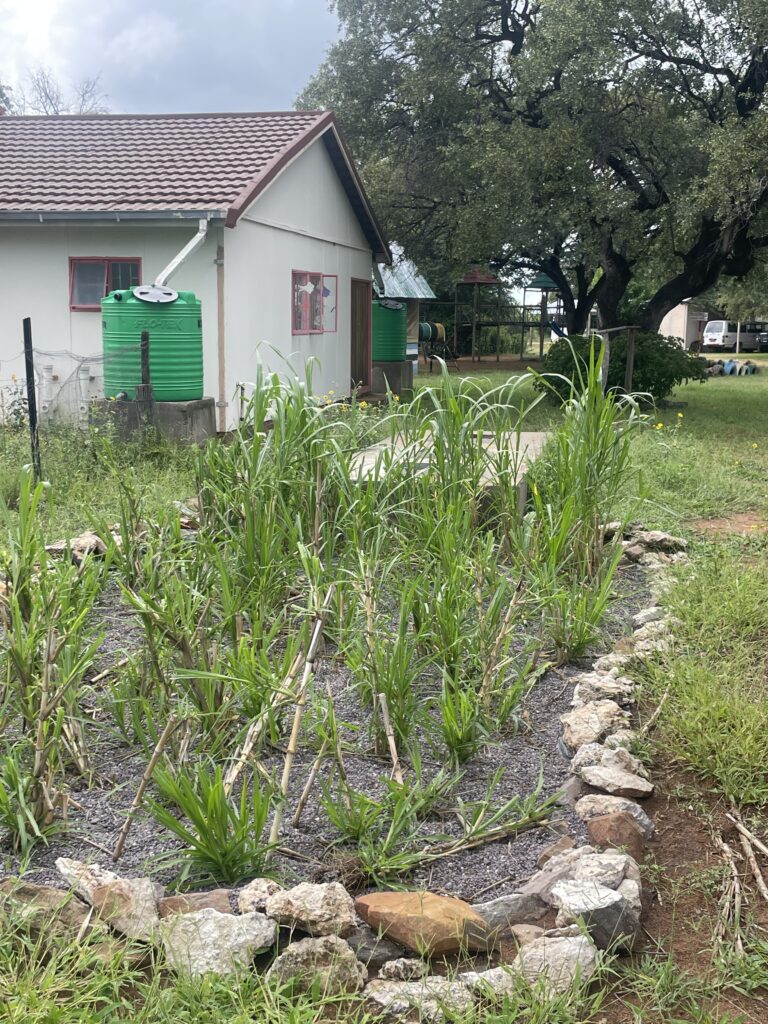
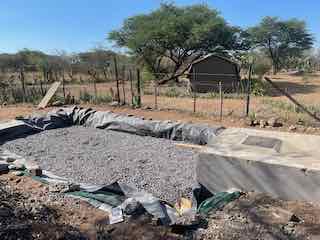
- 5 planted gravel filter beds (wicking beds) where clean water is absorbed by plants
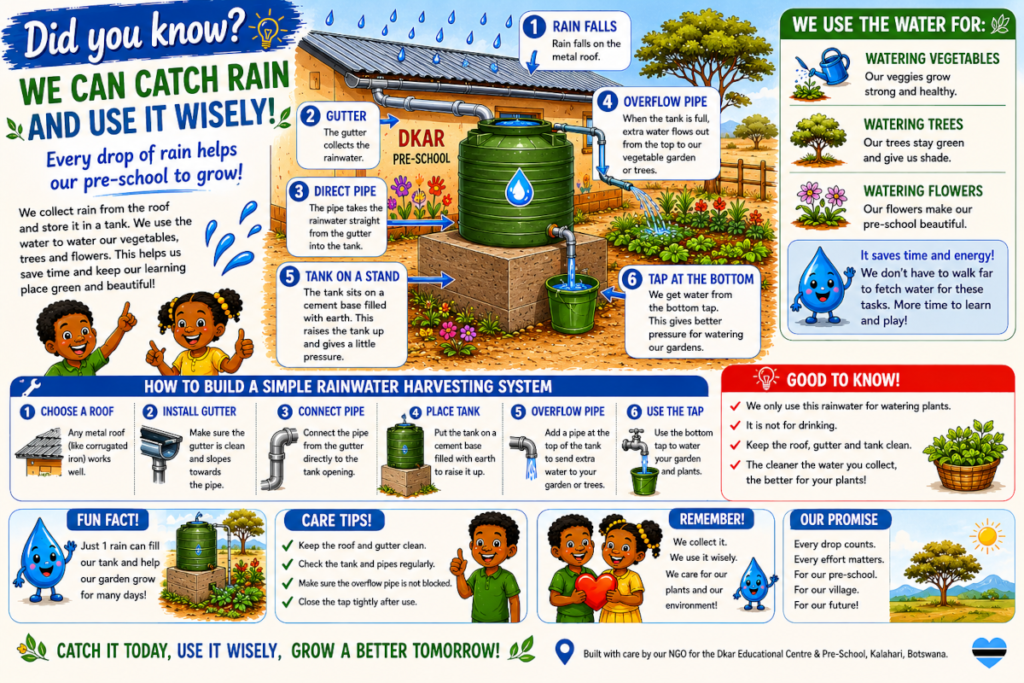
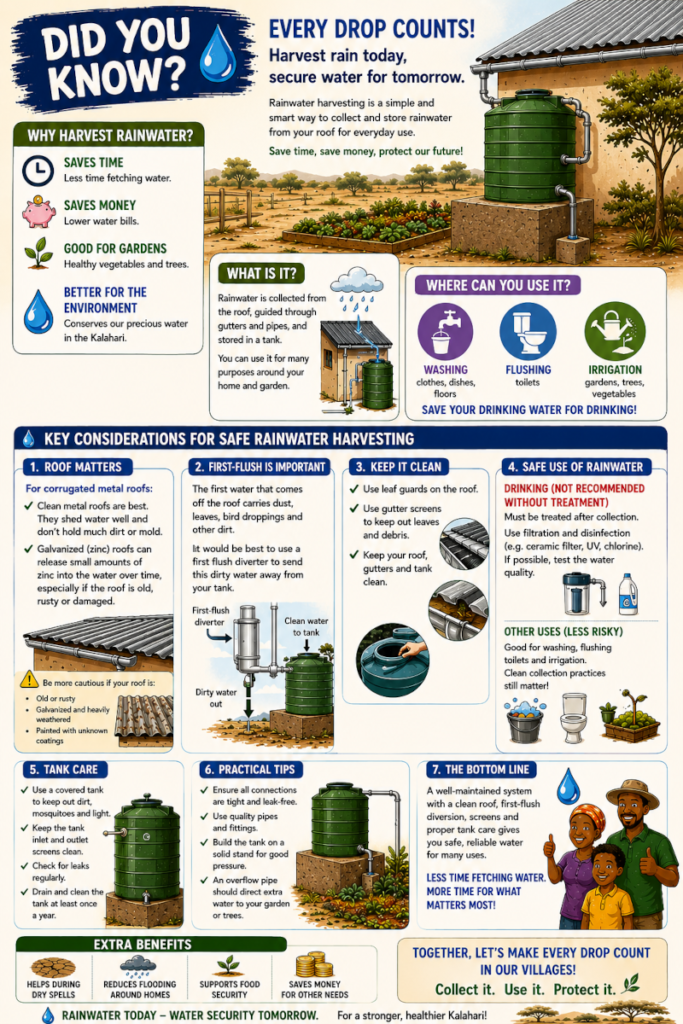
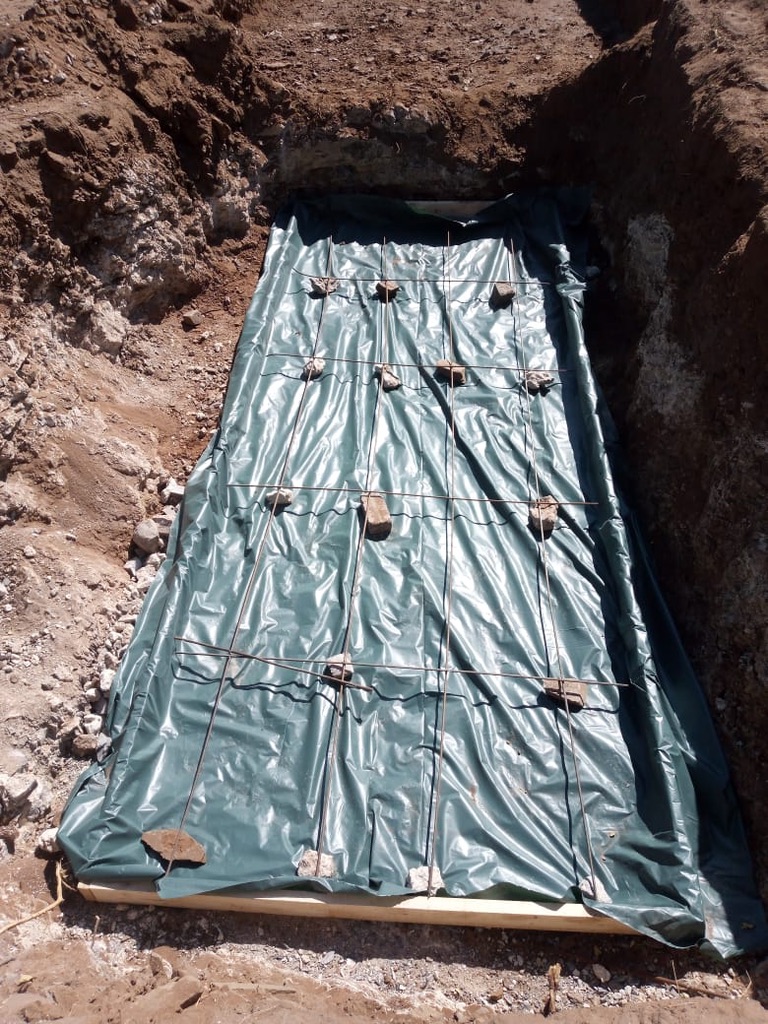
- 28 × 1,000-liter rainwater tanks on concrete foundations
- A solar-powered 12V pump for water-level regulation in one of the septic tanks.
- Napier grass grown in the filter beds, already used as animal fodder
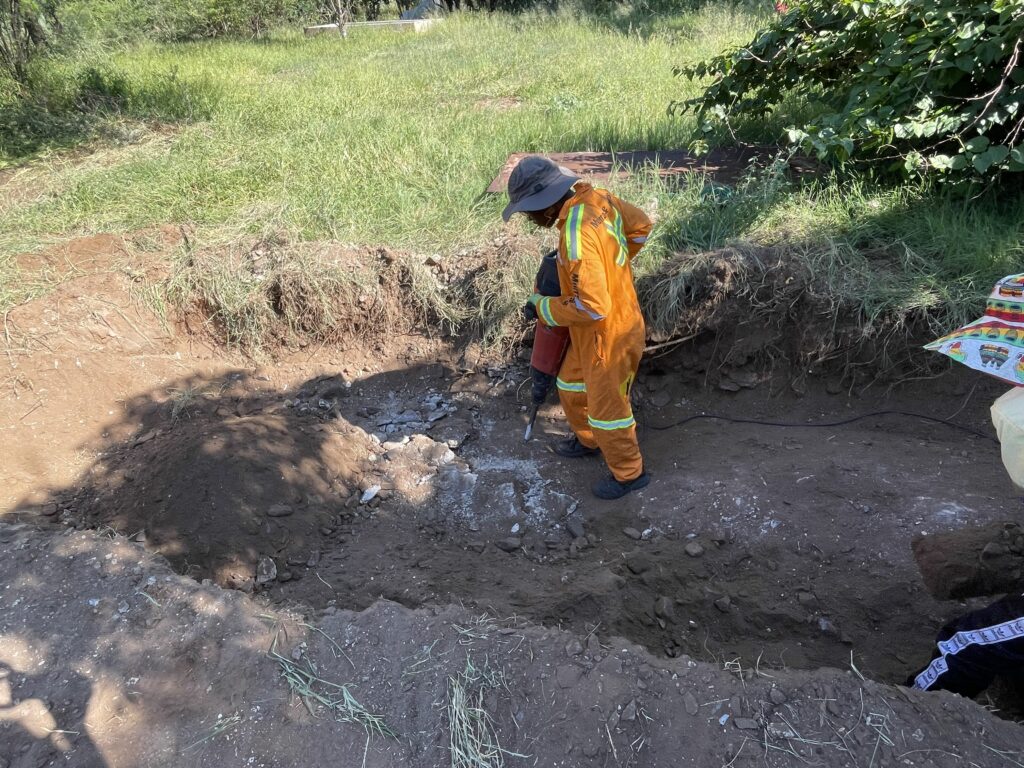
The system is fully functional, odor-free, and has withstood unusually heavy rainfall and challenging rocky soil.
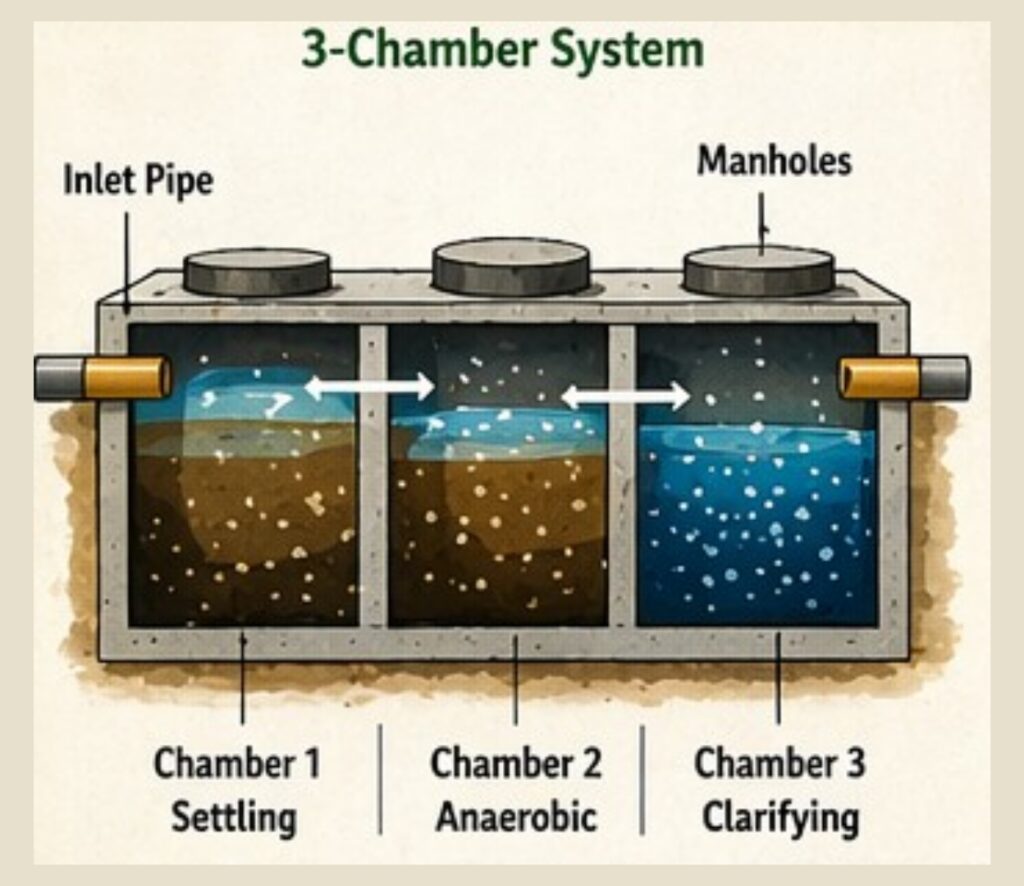
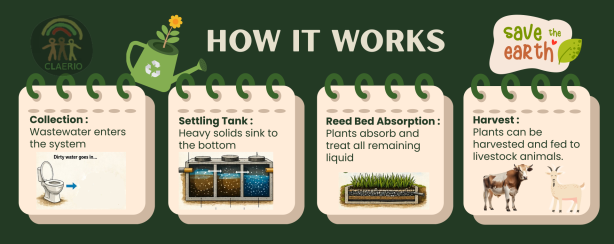
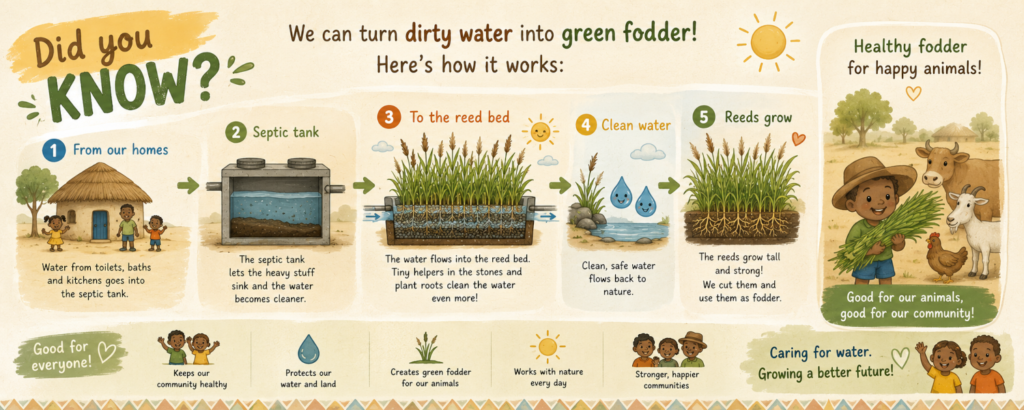
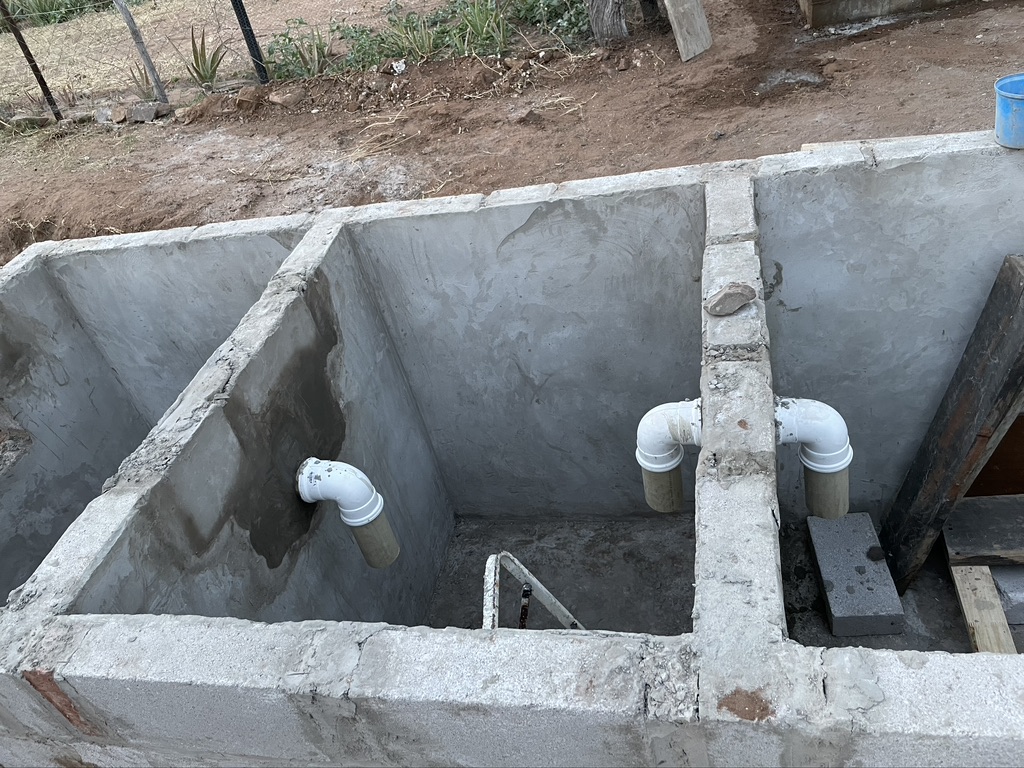
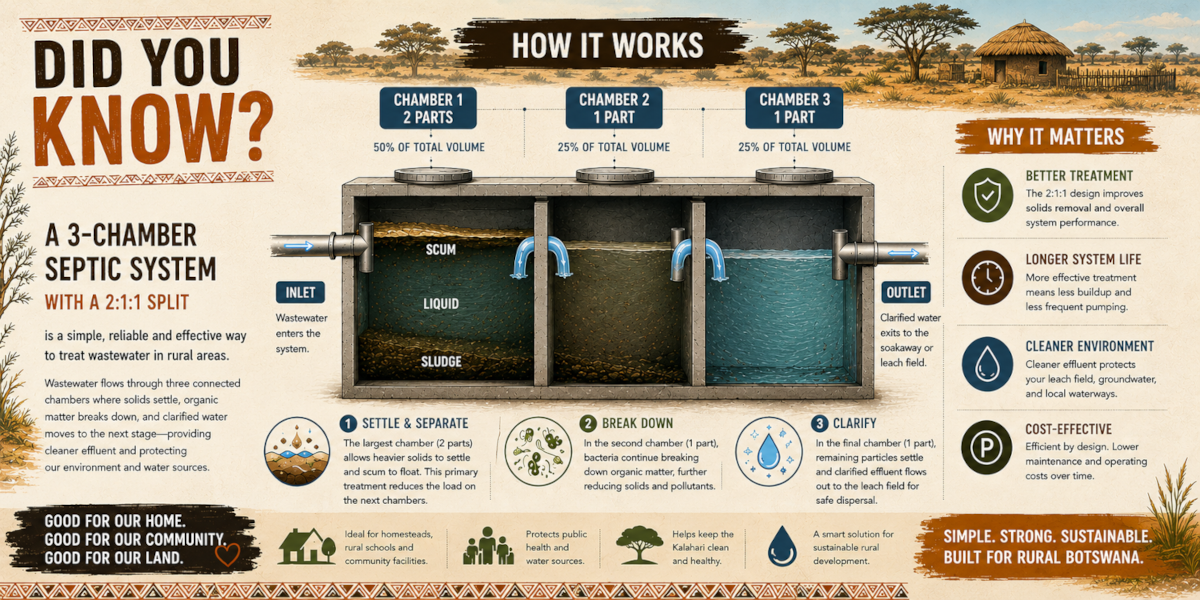
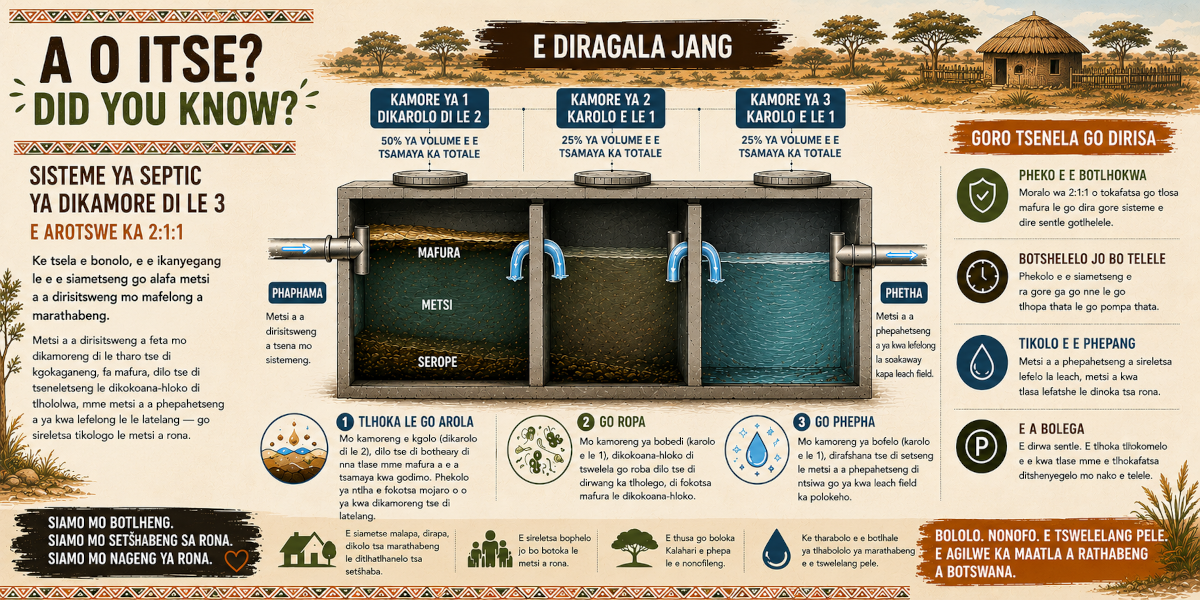
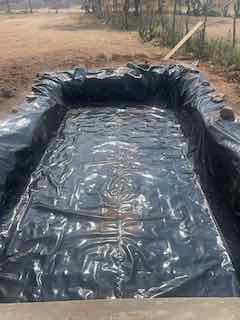
A three-chamber septic tank separates solids, fats, and clearer wastewater in stages, allowing the water to settle and partially treat before it flows into the planted filter bed.
Across the bush, three-chamber septic tanks are widely used, often with overflow directed into a simple soak bed, for example, a perforated pipe inside stacked used tyres wrapped in cloth, then covered with a grid and soil. Near urban areas or public facilities, regular pumping is another standard practice. Both are effective solutions suited to their contexts. At our center, given our space, water balance goals, and available plant materials, we opted for a constructed reed bed (planted gravel filter bed). It naturally treats and absorbs the effluent while producing useful plants, with no pumping, no chemicals, and no waste leaving the site.”
Why This Matters
This project is about more than plumbing. It shows how a rural education center can:
- Secure its own water and sanitation forever
- Cut costs for water transport, pumping, and maintenance
- Produce fodder from wastewater through Napier grass
- Teach children and the community about sustainability, water cycles, and resource conservation
- Offer a model that other villages, schools, and lodges can copy
Children learn by seeing, not just hearing. Parents and local leaders see that bio-treatment works, even in harsh conditions.
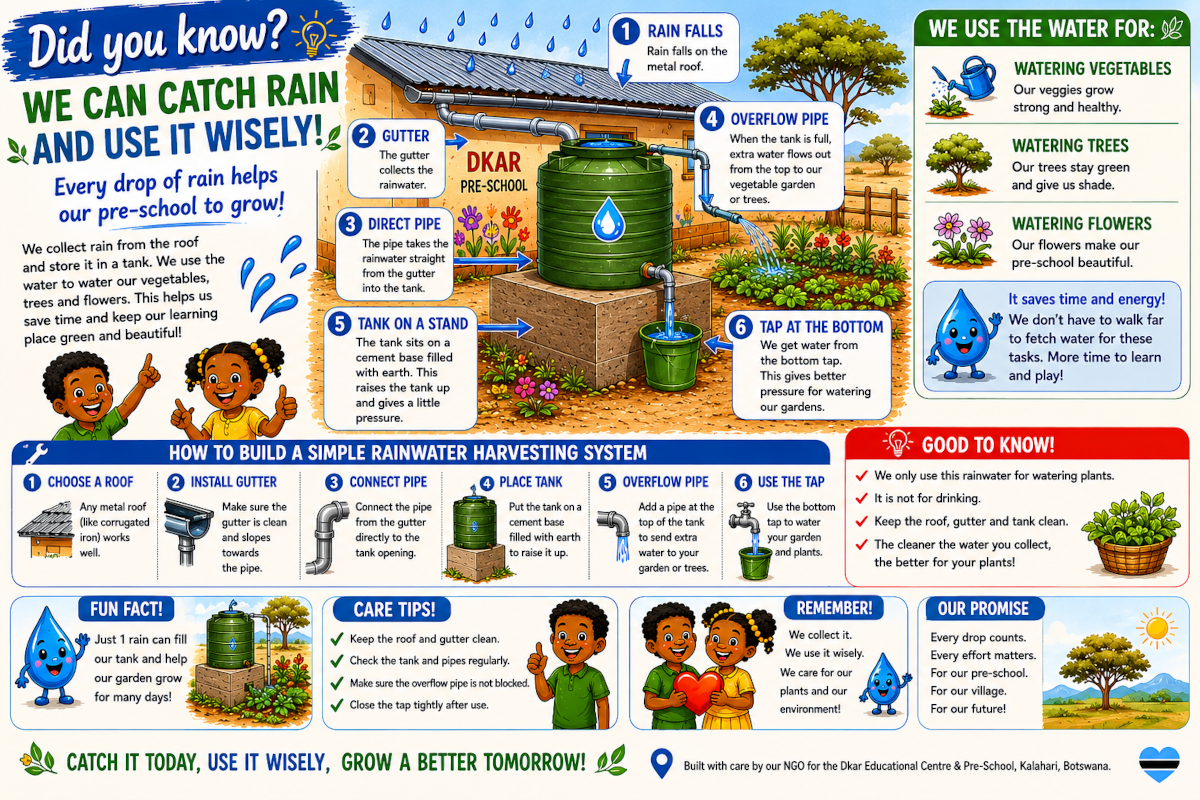
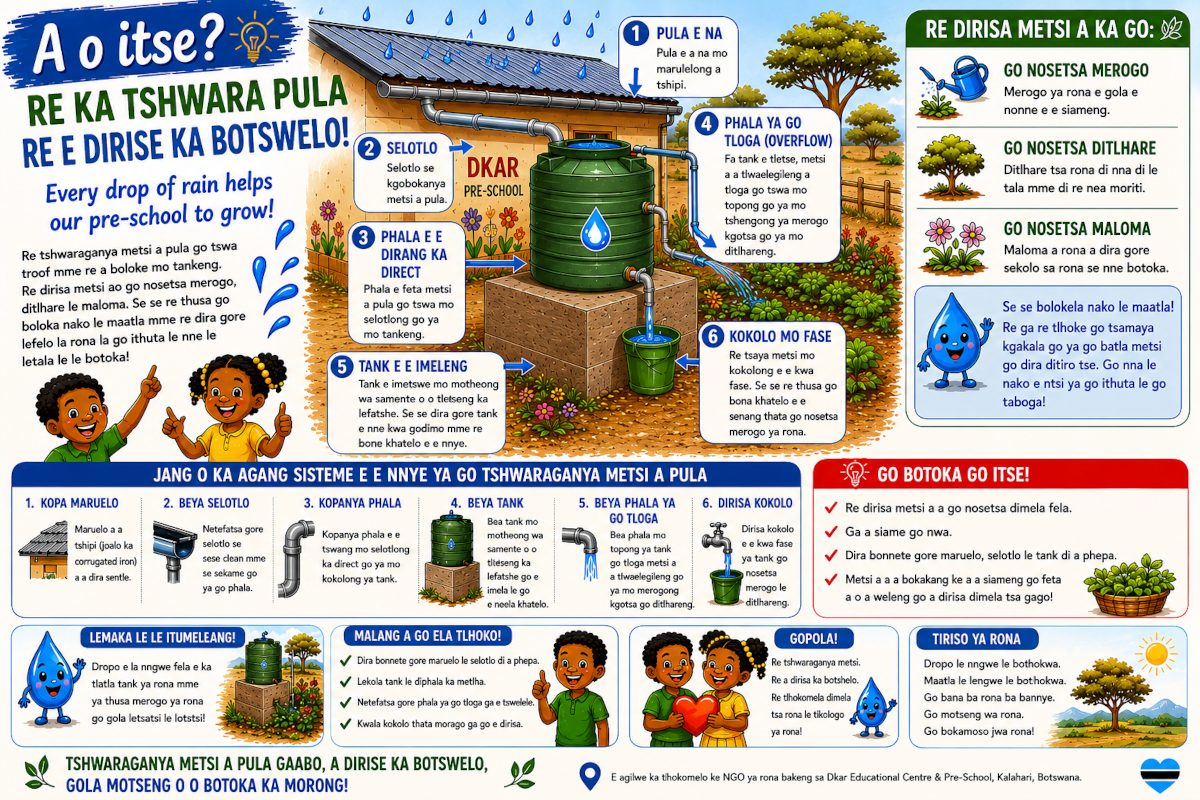
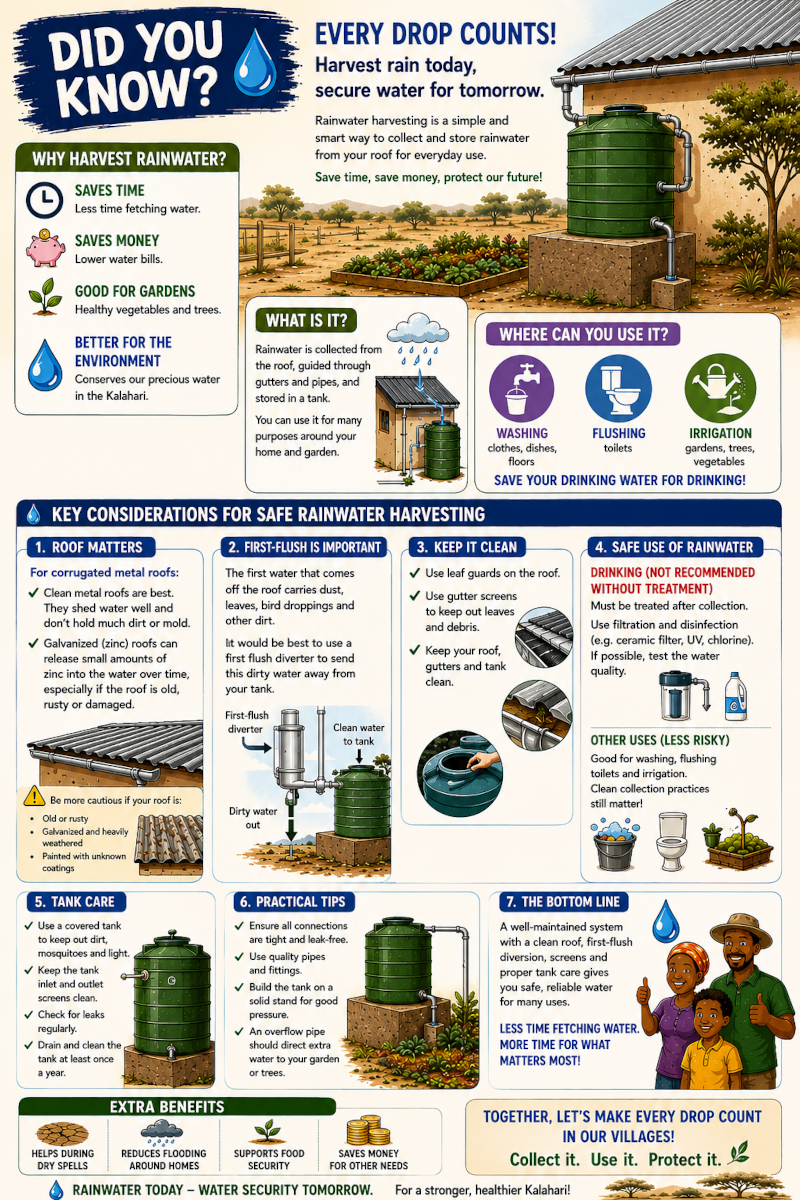
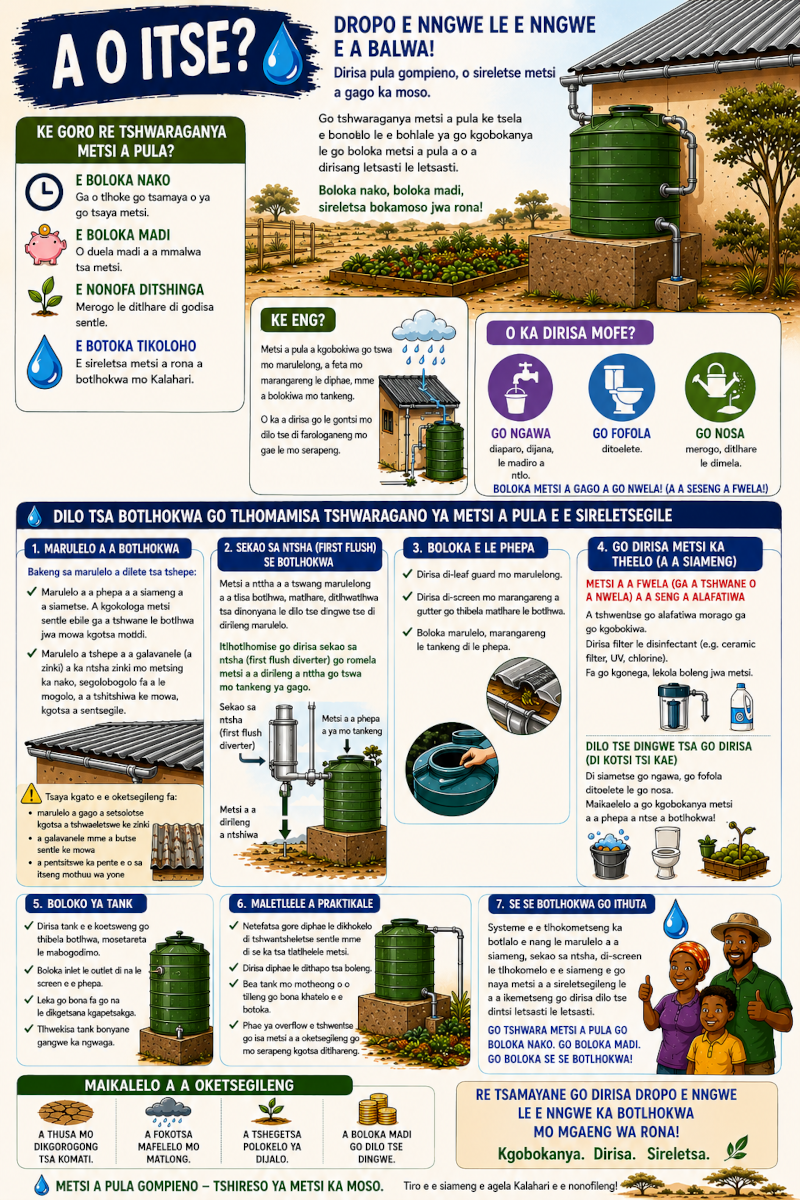
Rain Water Harvesting
How to Size a Three‑Chamber Septic Tank and Gravel Filter Bed
Simple Guide for the Kalahari, Botswana
Important Notice – Please Read First
- This guide is provided for educational and informational purposes only. It reflects our real-world experience building a bio-water system in D’Kar, Botswana, but it is not a substitute for professional engineering advice or official building regulations.
- Before constructing any septic system, wastewater treatment facility, or rainwater harvesting structure, you must check with your local building authorities, council, or Ministry of Land Management, Water and Sanitation Services. Regulations vary by Country, district, and your site may have specific soil, groundwater, or setback requirements that this guide does not address.
- The formulas and dimensions shown here worked for our specific conditions in the Kalahari. Your situation may differ. Always consult a qualified technician or engineer before breaking ground.
This section shows you how to calculate the size of a three‑chamber septic tank, and a gravel filter bed (reed/wicking bed) that follows it, using simple formulas adapted for the Kalahari climate (hot, dry, high evaporation, low rain).
Part 1 – Sizing the Three‑Chamber Septic Tank
Step 1: How many people?
Count the people the system must serve: We’ll use a 4‑person household as an example.
Step 2: How much water per person?
Reed bed sizing depends heavily on how much wastewater you send into the system, which varies widely by household habits, plumbing fixtures, and location. In many parts of the world, average household water use is around 100–150 liters per person per day, while in the United States indoor use averages about 227 liters per person per day, with toilets alone accounting for roughly 24–30% of that total.
In rural Botswana, per-person use can be much lower, studies in Ngamiland show around 20 liters per person per day, reflecting limited water access and low-flush or non-flush sanitation. For our Kalahari project, we are sending only toilet wastewater into the reed bed, while greywater from the kitchen and bathrooms already feeds separate plant beds that support on-site irrigation across the premises. This means our system handles blackwater only, and we design for 100 liters per person per day as a conservative, low-use figure appropriate for the Kalahari.
For other households, the actual load can vary significantly depending on toilet type and age: older toilets can use 19–26 liters per flush, standard modern toilets use around 6 liters per flush, and high-efficiency models use 4.5–4.8 liters per flush, so daily toilet water use per person can range from about 18 to over 100 liters depending on flush frequency and fixture efficiency.
Daily wastewater flow for our Example:
| Flow = People x 100 |
| 4 x 100 = 400 liters per day |
Step 3: How big should the tank be?
A septic tank needs enough volume to:
- Let solids settle to the bottom as sludge
- Let fats and oils float to the top as scum
- Provide enough retention time for anaerobic bacteria to start breaking down organic waste
For small households, a widely used rule of thumb is:
| Tank volume (liters) = 2,000 + Daily wastewater flow (liters) |
This ensures a minimum base capacity of 2,000 L (common in many standards for small dwellings) plus extra volume to handle your household’s daily flow comfortably. Example for our Kalahari household (4 people, 100 L/person/day):
Daily flow = 4 x 100 = 400 L/day
Tank volume = 2,000 + 400 = 2,400 L
In practice, we build a 2,500–3,000 liter tank to:
- Add a safety margin for occasional higher use (e.g., guests)
- Ensure longer retention time and better treatment
- Allow for sludge and scum accumulation between desludging visits
This size is appropriate for a small household sending only toilet wastewater to the septic tank, with greywater from kitchens and bathrooms going to separate plant beds and / or for irrigation.

Step 4: Divide the tank into 3 chambers
A 3-chamber septic tank gives wastewater several stages to settle and clarify, which produces much cleaner effluent for your reed bed. Inside the tank:
- Chamber 1 (primary settling): All wastewater enters here first. Heavy solids sink to form sludge, light fats and oils float as scum, and the middle layer (effluent) begins to clear.
- Chamber 2 (secondary settling): The effluent flows here for further settling, allowing finer particles to drop out and more anaerobic digestion to occur.
- Chamber 3 (final clarification): A final polishing stage where any remaining fine particles settle before the effluent leaves the tank toward the reed bed.
For a 3,000 L tank, a widely used best-practice split is 50% / 25% / 25%:
| Chamber | Purpose | % of volume | Volume |
|---|---|---|---|
| Chamber 1 | Primary settling | 50% | 1,500 L |
| Chamber 2 | Secondary settling | 25% | 750 L |
| Chamber 3 | Final clarification | 25% | 750 L |
For a tank with a constant width and depth, these volumes can be easily achieved by using a length ratio of 2 : 1 : 1 for the three chambers. This 50/25/25 split is the most common guidance for 3-chamber septic tanks; some designs use other ratios (for example, 50/30/20 or a 2/3–1/3 two-chamber split), but they all follow the same principle: the first chamber is the largest, and the later chambers are smaller to provide progressive settling and clearer effluent.
This design ensures:
- Strong initial separation of solids and scum
- Extra settling time in the second chamber
- A final clarification step that protects your reed bed from clogging
Part 2 – Sizing the Gravel Filter Bed (Reed/Wicking Bed)
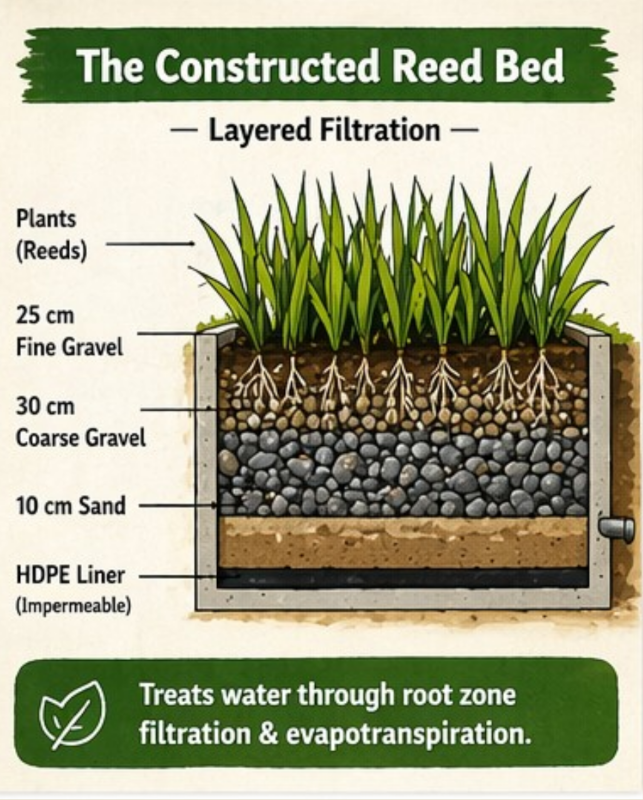
The gravel bed treats the water from the septic tank and uses plants (e.g., Napier grass) to absorb it.
Step 1: Flow to the bed
Assume all treated effluent from the septic tank goes to the reed bed. For our example, that is 400 liters per day.
Step 2: Choose a loading rate
The loading rate is the amount of wastewater that 1 square meter of bed can treat each day. In the hot Kalahari climate, with strong plant growth and good evaporation, a practical design value is 80 liters per square meter per day.
Step 3: Calculate the bed area
Formula:
For our example:
To add a safety margin, we recommend building a bed of about 6 to 7 m².
For example: 2 m × 3 m = 6 m²,
or 1.5 m × 4 m = 6 m².
Step 4: Choose bed depth: 0.6–0.8 meters
For our Kalahari demonstration with and Napier grass we used 0.7 m to 0.8 approximate depth.
The Formula:
Example: 6 x 0.7 = 4.2m³ or 6 x 0.8 = 4.8m³ of gravel/sand media
Quick Summary for a 4‑Person Household in the Kalahari
| Item | Size / Value |
|---|---|
| People | 4 |
| Water use per person | 100 L/day |
| Daily wastewater flow | 400 L/day |
| Septic tank volume | 2,500–3,000 L |
| – Chamber 1 | ~1,500 L (50%) |
| – Chamber 2 | ~750 L (25%) |
| – Chamber 3 | ~750 L (25%) |
| Gravel bed area | ~6 m² (e.g., 2 m × 3 m) |
| Gravel bed depth | 0.7 m – 0.8 m |
| Gravel/sand media volume | ~4.2 m³ – 4.8 m³ |
Why This Works Well in the Kalahari
- High evaporation and strong plant uptake help remove water.
- With healthy Napier grass, the bed can absorb all treated water with no discharge.
- The system is simple, low‑cost, and easy to maintain.
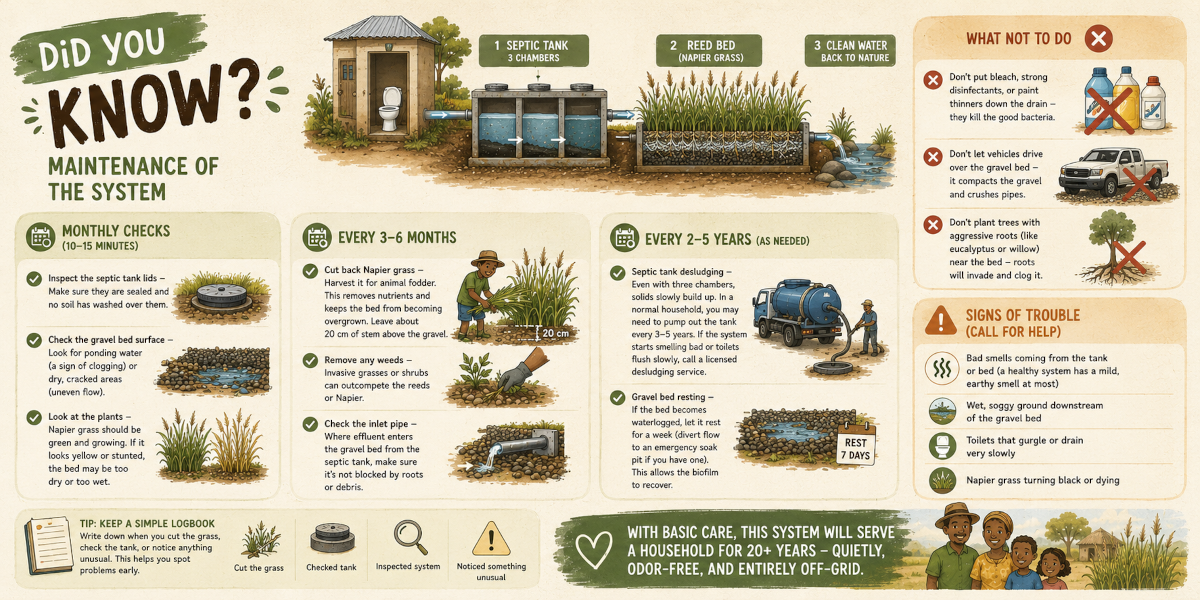
System Maintenance:
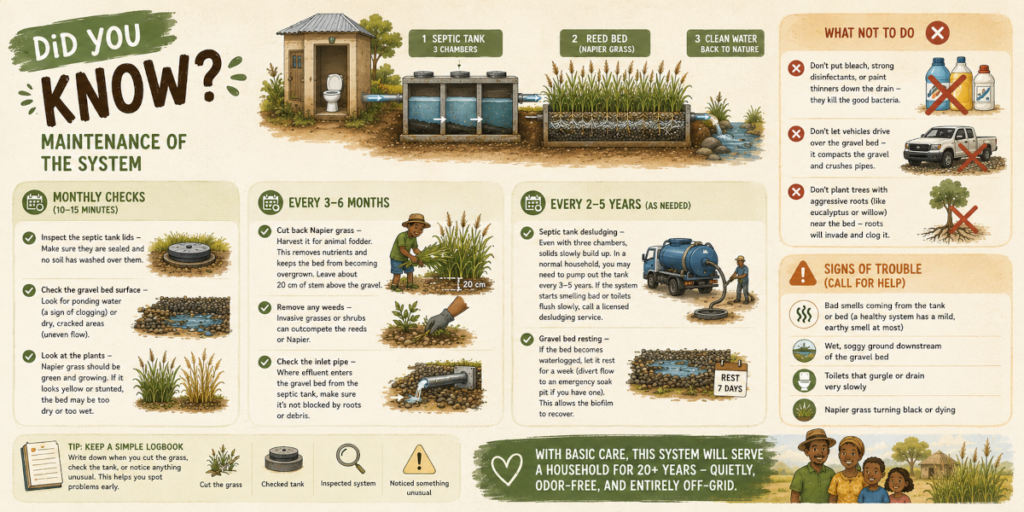
The same steps can be used for schools, community centers, or lodges alike.
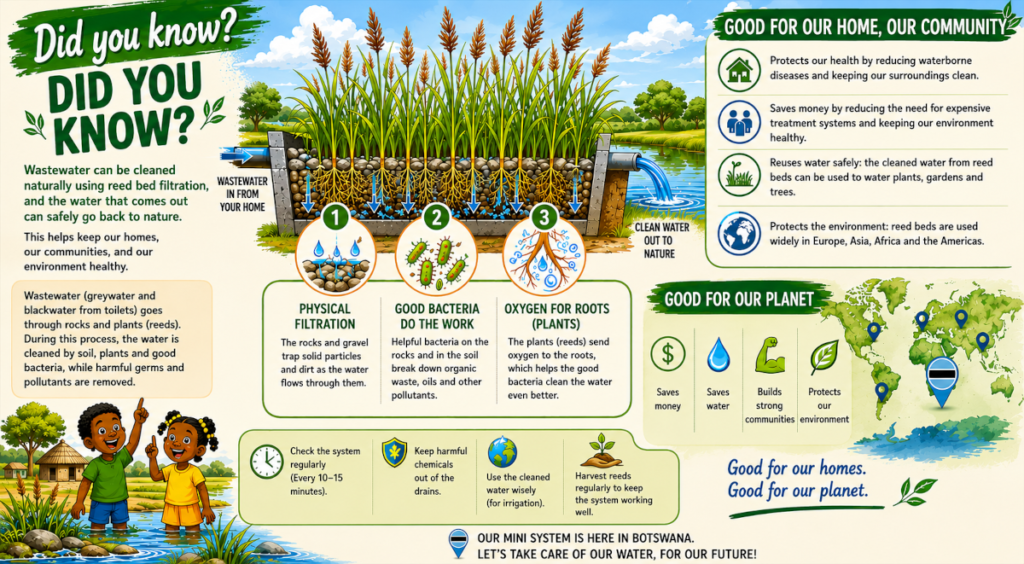
Explore Our Infographics
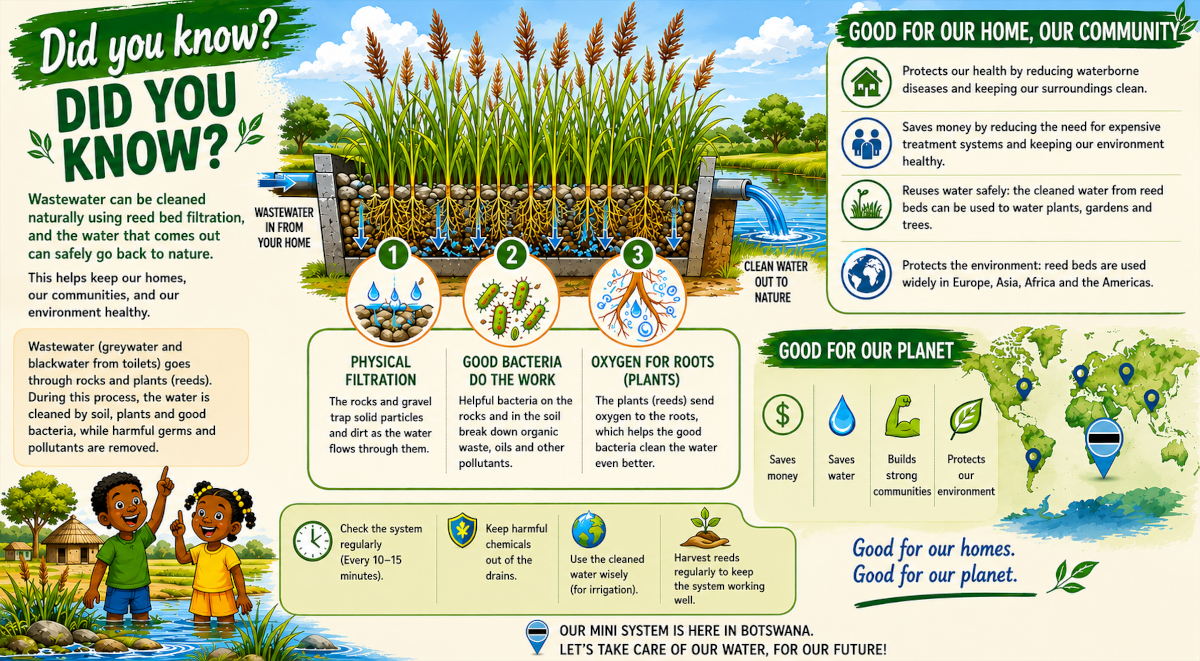
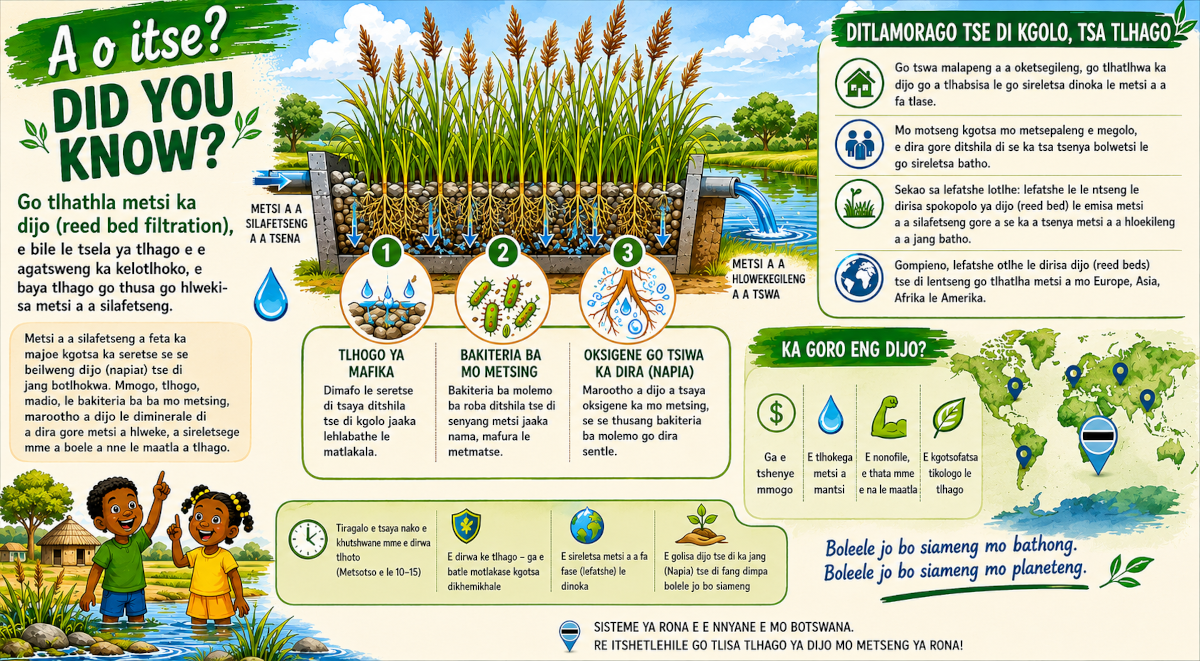
Below you’ll find simple, easy-to-understand infographics that explain:
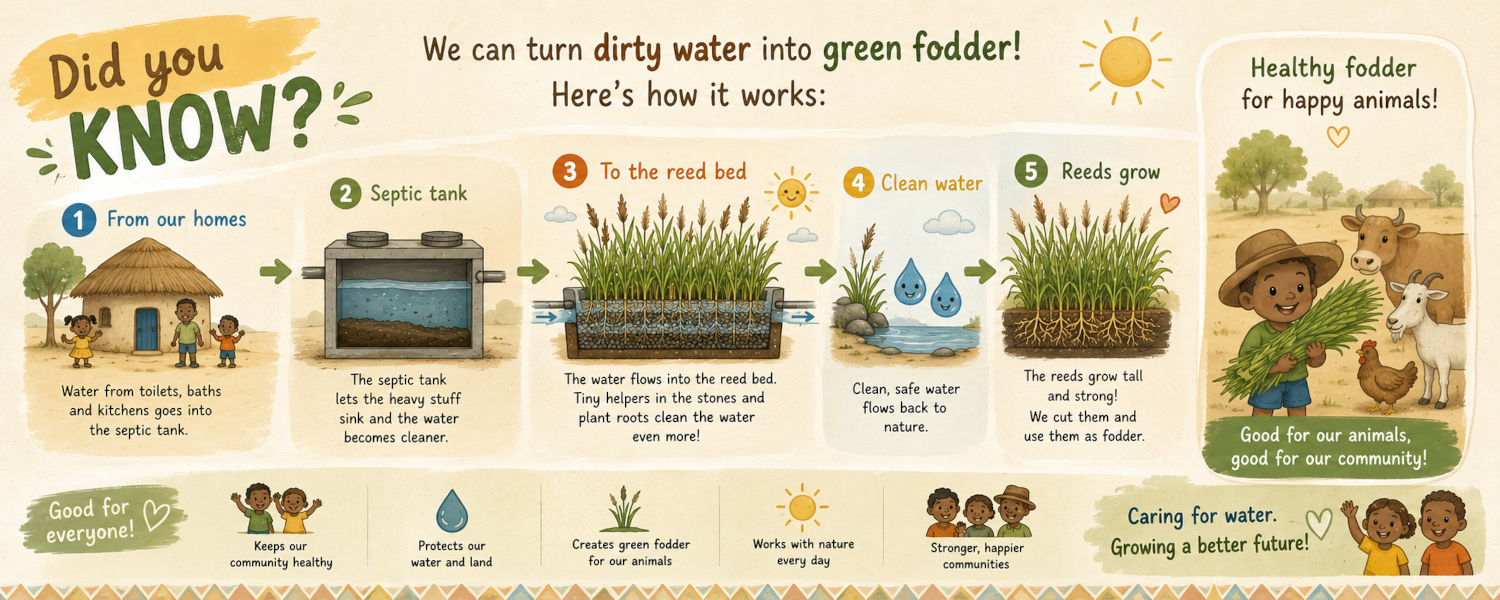
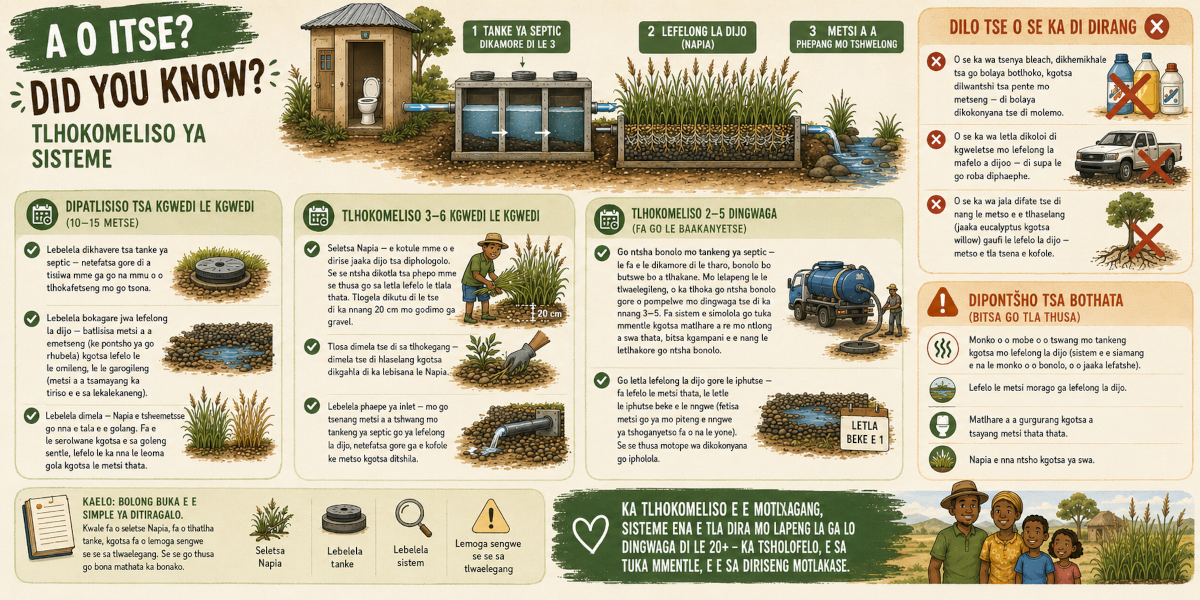
- How the three-chamber septic system works
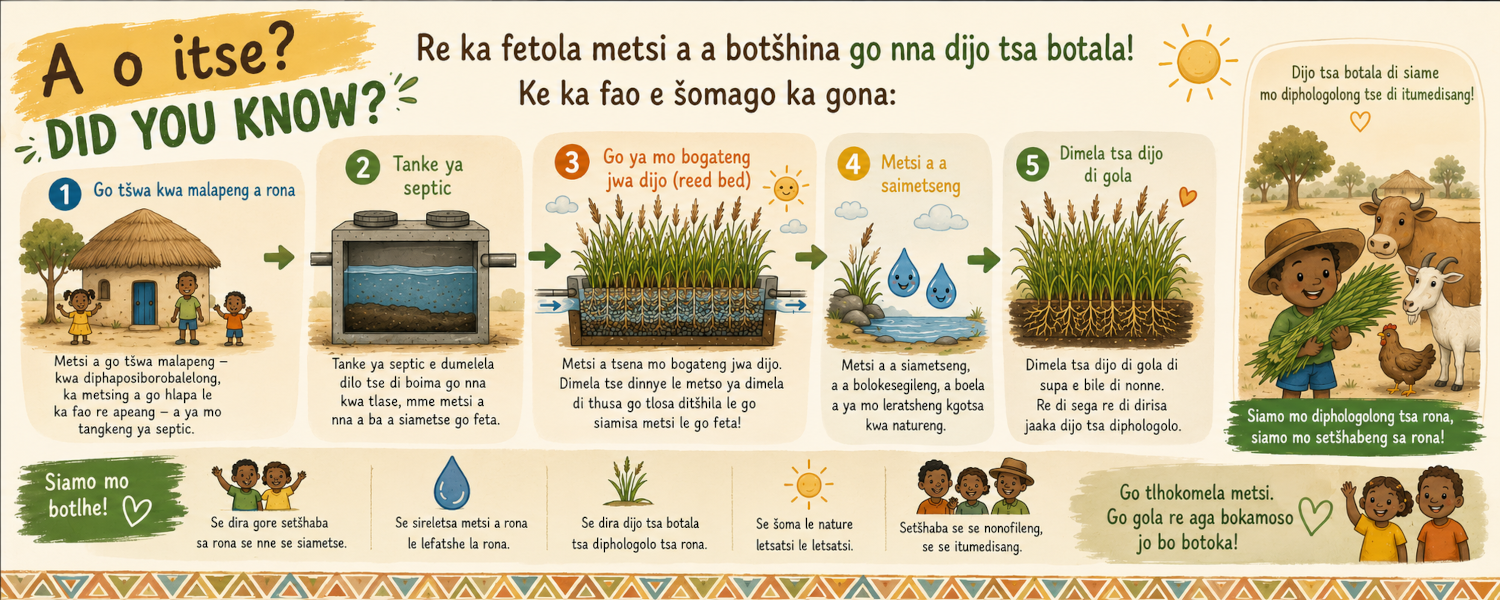
- How wastewater becomes plant food
- How rainwater is collected and stored
Download the Infographics:
Download all infographics as a ZIP file in English
Download all infographics as a ZIP file in Setswana
Download all Sketches as a ZIP
Did You Know: Rain Water Harvesting_PreK_ in English
Did You Know: Rain Water Harvesting_PreK_ in Setswana
Did You Know: Rain Water Harvesting_ in English
Did You Know: Rain Water Harvesting_ in Setswana
Did You Know: Reed Bed Filtration_ in English
Did You Know: Reed Bed Filtration_ in Setswana
Did You know: Water Cycle Overview_PreK_ in English
Did You Know: Water Cycle Overview_PreK_ in Setswana
Did you Know: 3 Chamber Septic Tank_ in English
Did you Know: 3 Chamber Septic Tank_ in Setswana
Did you know: System Maintenance_ in English
Did you know: System Maintenance_ in Setswana
Quick facts:
- Location: D’Kar, Botswana
- Partner organizations: Rheingauer Jugend für Afrika e.V. (Germany), Mosaico (local partner), Italian partner organization
- Buildings served: 5 (school, kitchen/dining, staff house, manager house, volunteer house)
- People directly involved: 20 staff members, 110 school children per year
- Indirect beneficiaries through knowledge sharing: 500 + D’Kar and Beyond
- Community reach: D’Kar and surrounding areas
- Supported SDGs: 4 (Quality Education), 6 (Clean Water & Sanitation), 7 (Clean Energy), 11 (Sustainable Communities), 12 (Responsible Consumption), 15 (Life on Land)
Funded by:


& by the People of the State of Hessen

Gallery:
“Thank you from Botswana!” – The local team in D’Kar